

Far off the coast of Baja California lies Socorro – a remote volcanic archipelago where the ocean still feels wild and alive. Giant manta rays move with effortless grace, and dolphins often appear out of nowhere, curious and unafraid.

What Is Socorro?
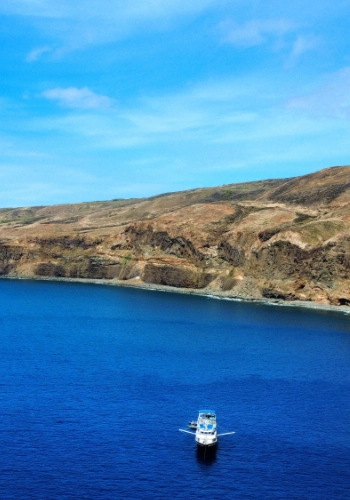
The Revillagigedo Archipelago, roughly 400 kilometers off the southern tip of Baja California, is made up of four volcanic islands rising from the Pacific. Most divers simply call it Socorro, after the largest island — named by a Spanish explorer in 1608 after Nuestra Señora del Socorro, “Our Lady of Perpetual Help.”
It is one of the most extraordinary dive destinations on Earth — a UNESCO World Heritage Site, almost entirely uninhabited, where marine life exists on a scale that defies expectation. Giant Pacific manta rays with wingspans of up to seven meters swim straight toward you, looking you in the eye. Bottlenose dolphins seek out divers to play. Schools of hammerheads move through the blue. During the season, humpback whales sing in the distance.
The crossing from Cabo San Lucas takes around 30 hours each way — a long journey at sea. But every single time one of our travelers returns from Socorro, they come back with glowing eyes and stories they’ll tell for the rest of their lives.
Our client Manuel F. had just returned from his liveaboard trip with Nautilus Adventures aboard the Nautilus Explorer, and his eyes said it all — pure happiness. We sat down to talk about what it’s really like to dive one of the wildest places on Earth.
“The worst dive in Socorro is three times better than the best dive anywhere near where I live. It’s not about whether you have a good dive — it’s about how good your dive is.” – Manuel F.
Why Socorro? The Decision to Go
Diving Socorro is not an impulse decision. The remote location, the liveaboard-only access, the 30-hour crossing – it takes a certain kind of diver to say yes. I wanted to understand why Manuel chose Socorro and what he was hoping to see.
You've dived in a number of places including the Galápagos. When I told you about Socorro, I couldn't hide my excitement. What was your first reaction and what made you say yes?
It was totally crazy when you said Socorro was on the same level as the Galápagos, because for me, the Galápagos was simply in a league of its own. I've dived all over the world, and then I went to the Galápagos — and everything else was way below that. When you said, "Hey, Socorro is on the same level," I honestly couldn't believe it at first but I wanted to see it with my own eyes. And honestly, until I was on the boat and until I did my first dives, I still didn't quite believe it 100 percent. But now, I do believe you!
Had you done a liveaboard trip before? And what were your expectations going in — were you nervous, excited, a bit of both?
I had done the Galápagos, which was also a liveaboard. Other than that, I'd always done day trips. But I have to say, comparing the boats from the Galápagos to Socorro, it was an extreme difference. The Nautilus Explorer boat was absolutely incredible. Plenty of space, amazing food — I'm pretty sure I gained about 2 to 3 kilos in one week. But by far the most impressive thing was the crew. I genuinely don't think I've ever met such friendly people in my life. We got on the boat and I thought: wow, you're so friendly — let's see how long that lasts. But it wasn't fake at all. The helpfulness and enthusiasm from everyone was just incredible — every single person, from the dive guides to the cook, the captain, the deckhands, the mechanic. Every single one was so genuinely warm. It was just amazing.
The Journey Out – 30 Hours at Sea
The crossing to Socorro is part of the experience. The open Pacific Ocean stretching out in every direction. For many divers, it is the first moment they truly understand how remote this place is.
The crossing from Cabo San Lucas to Socorro takes around 30 hours - a full day and more at sea before you even get in the water. How did that feel, and was there a moment when it really hit you how remote this place is?
During the crossing, there was nothing around us but open water. That's when it really hit me — this place is truly remote, far away from civilization — and my excitement just kept growing.
Did you get seasick during the liveaboard trip — and if so, did it affect the trip?
I was a bit worried about seasickness at first. But those patches you put behind your ear worked really well. Right next to the dive shop where we met before departure, there's a pharmacy. I was a bit late to figure this out, but when I arrived in the evening for check-in, almost every guest already had a patch behind their ear. So I ran to the pharmacy and the woman behind the counter even shaved a small spot on my neck and stuck it on for me. It worked perfectly. On the way back we had a lot of wind — the captain had warned us — and there were a moment or two where it got a bit rough, but everything I ate stayed down ;-)! And honestly, it's all part of what makes it so special.
What was your first impression when you finally arrived in Socorro and slipped into the water for the very first time?
We started with the check dive at a relatively unspectacular dive site, but I live in Tenerife, and the best dive I've ever done there wasn't even a third as good as the worst dive in Socorro. Even this dive was great. I was looking at an octopus and my buddy tapped me on the shoulder: hammerhead. I look at the hammerhead and then — "wait, manta!" I look over and there's a manta coming around the corner. That was just super cool.
Face to Face with Socorro’s Marine Life
This is what people come for. Socorro diving is defined by close, unforgettable encounters with animals that show no fear and in some cases seem genuinely curious about the humans in their water.
Manuel walked me through the moments that stayed with him:
The Giant Manta Rays of Socorro
Giant Pacific manta rays are the signature encounter at Socorro. Unlike most places in the world where mantas glide past at a distance, here they come to you.
Socorro is known above all for its giant manta rays that seem to actively seek out divers. Can you describe what it was actually like to be in the water with one? Did it live up to what you had imagined?
It was absolutely incredible. I cannot describe the feeling. One absolutely amazing moment was when we were diving at "El Boiler" — one of my favourite dive sites. So many mantas. It was almost like an Avatar moment. On one dive we had seven mantas, the largest one had a wingspan of probably six and a half to seven meters. They were circling around us. There was a moment where I was literally belly to belly with a manta — we swam toward each other, I went up, and the manta was right in front of me. You couldn't see anything else. Just manta rays. We also had two manta researchers on board who gave talks every evening — that was just brilliant.

The Sharks in Socorro
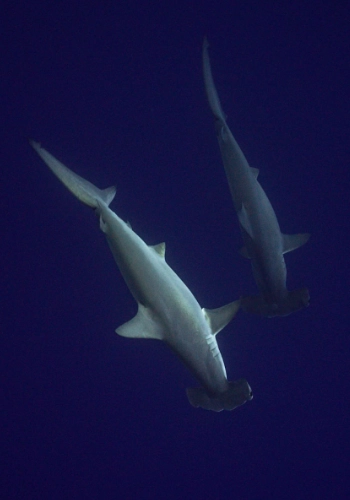
Diving Socorro means diving with sharks, more than 12 species, often on every dive. It is one of the few places on earth where you might find yourself surrounded by schooling hammerheads, silky sharks, Galápagos sharks, and whitetips all on the same day.
Let's talk about the sharks in Socorro. What was the encounter that surprised you most, whether that was the species, the sheer numbers, or just the feeling of being there with them?
I think the sharks that surprised me most were actually the whitetips at Roca Partida.
I knew there would be sharks in Socorro, and of course I was dreaming of hammerheads – and we really did get those classic scenes where you're suddenly surrounded by them, which was just mind-blowing.
But what also really stunned me was the amount of and the way the whitetips were just piled up in those little caves. You shine your torch in and it's not just one or two sharks, it's this whole stack of them, literally lying on top of each other, completely relaxed, as if it's the most normal thing in the world.
And then you're just there, hovering in front of this rock in the middle of nowhere, with sharks, mantas and sometimes dolphins all sharing the same space. That combination – the remoteness, the amount of life, and how calm the animals are around you – that was the part that surprised me the most. It felt less like 'seeing sharks' and more like being briefly allowed into their world.

The Unexpected
The ocean always has something unplanned. Humpback whales, whale sharks, dolphins that appear from nowhere, surprises are part of every trip.
Were there any unexpected encounters while you were diving? Something you didn't expect to see, but that you'll never forget?
How much time do you have? After many dives I wrote in a little notebook I carry, giving each dive a title. One I called 'Dance of Dolphins and Mantas' — because it was just incredible. Four mantas circling the whole time, and directly below them a group of about ten dolphins standing upright, looking up at us, and then swimming up through the mantas. And there were so many dives where you could hear the humpback whales the whole time — so loud. I kept thinking: okay, they must be right around the corner. We unfortunately didn't see them underwater, but just hearing them that clearly was already amazing.
Roca Partida
Roca Partida is often described as the most extraordinary dive site in the Socorro archipelago: a tiny pinnacle rising from deep Pacific water, barely above the surface, but absolutely swarming with life above and below.
What was your experience diving Roca Partida? Did it live up to its reputation?
100%. Roca Partida — just this rock in the middle of nowhere. No matter where you look, it's just ocean, and then this rock sticking out of the water. The most incredible marine life: dolphins everywhere, we heard whales underwater, mantas on every single dive. And the whitetip reef sharks literally stacking on top of each other. It was just crazy — really, really cool.

Life on a Liveaboard – The Full Picture
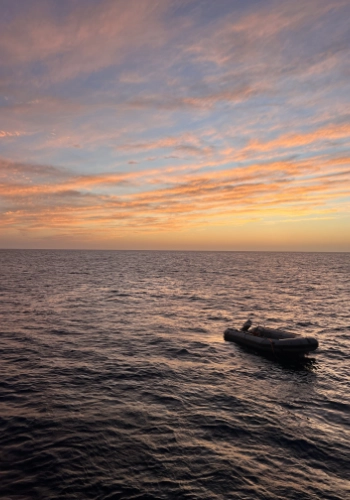
A Socorro trip is not just about what happens underwater. You are living on a boat for over a week, sharing meals and surface intervals with a small group of divers, watching sunsets from the deck, falling asleep to the sound of the ocean. That experience is part of the whole.
Soon, the rhythm of the boat takes over and the ocean is setting the pace for everything you do.
How did the rhythm of liveaboard life feel to you - the briefings, four dives a day, the time between dives, the nights at sea?
Honestly, I loved the rhythm. Four dives a day plus briefings sounds intense on paper, but you slip into it so quickly — it just becomes your new normal: wake up, briefing, dive, eat, repeat.
The briefings were super helpful and really built the excitement, and the time between dives was this perfect mix of recovering, eating way too well, and sharing stories with the crew and other divers. And I also loved the nights at sea: you really feel how far away you are from everything. Just the boat, the ocean, and the people on board. I could easily get used to that rhythm.
Is there a moment - above or below the water - that you think you'll still be talking about years from now?
There isn't just one moment – it's the whole experience. The constant feeling of being really close to these wild animals is what sticks with me the most. Whether it was mantas circling us again and again, dolphins hanging in the water watching us, or hearing whales sing in the background on so many dives – that overall sense of connection is what I'll be talking about for years. It felt like being a guest in their world, not just ticking off sightings on a list.
A Place Worth Protecting
The Revillagigedo Archipelago became a UNESCO World Heritage Site in 2016 and a fully protected marine reserve in 2017. Visitor numbers are strictly limited. The absence of human pressure is exactly why the wildlife behaves the way it does and why diving Socorro feels so different from anywhere else.
How did it feel to dive in a place where the ocean is still completely wild and protected? Did you feel a difference compared to non‑protected areas?
This is just how the ocean should be. I've been to so many places in the world — Southeast Asia, Central America, here in Tenerife — where you really strongly feel the human impact underwater. Bleached coral, damaged reefs. The Great Barrier Reef in Australia was genuinely underwhelming and honestly quite sad — so much of it is just gone. And then you jump into Socorro and even the worst dive there is three times better than the best dive anywhere near here. It's not about whether you have a good dive — it's about how good your dive is.
Many divers describe Socorro as a trip that shifts something in them. Did it change anything for you, e.g. in how you think about the ocean, about diving, or about what you want to do next?
The experience in Socorro gives me so much hope — not just as a diver, but as a father — that more places like this can exist, so that future generations, my son, my grandchildren, can still experience something like this. That wish became so much bigger after seeing it firsthand.
What Would You Tell Someone Who Is Thinking About Going Diving in Socorro?
This is always the question we save for last – because no one describes a destination better than someone who has just come back from it.
Before you left, did you feel well prepared for your diving trip to Socorro? Did you have a clear picture of what to expect on the water, what the diving would demand, and what to bring?
Yes, I felt really well prepared. I had a pretty clear idea of what to expect in terms of conditions and logistics — long crossings, four dives a day, cooler water, stronger currents, big animals.
You'd given me super detailed info beforehand about the boat, the dive setup, and what to pack, so I never had that feeling of, 'Oh no, I'm missing something important.' Of course, what you can't really prepare for is how it feels emotionally when you're actually there, in the middle of the ocean with mantas, sharks and dolphins all around you. That part still completely blew me away.
What would you say to someone who’s still deciding whether to go to Socorro, e.g. maybe because of nervousness about the long crossing, the currents, or just the commitment of a week-long liveaboard?
Just do it. Seriously — just do it. Yes, you're spending a significant amount of money. But when you actually think about what you get in return, it's a complete no-brainer. You have accommodation for a full week. You're fed unbelievably well — the food is genuinely like going to a great restaurant for every single meal. You have four dives a day that are so mind-blowing you'll carry them with you for the rest of your life. There is absolutely zero chance you'll look back and say: I wish I hadn't done that. It is 1000% worth it.
And finally - would you go back to Socorro? And if so, what would you hope to experience next time?
Without a doubt. My wife has already said: "Manu, when the kids are older, let's do this together." And my son — I'm definitely going to make sure he becomes a diver. This is one of my biggest dreams: to experience Socorro again with my wife and my kids someday.


When to Go & How to Plan
The Socorro diving season runs from November to June, with manta rays and dolphins year-round, humpback whales from January to April, and warmer, calmer seas toward the end of the season. Each period offers something unique.
If Socorro is calling you, we’d love to help you plan your journey. At Mālama Earthventures, we work with trusted liveaboard partners and handle every detail so you can focus on what matters most: being there, in that blue, when a manta looks you in the eye.
Socorro liveaboards typically start from CHF 3.500 per person, depending on the vessel and cabin category. If you’d like to know what’s available for your dates, just get in touch.
If you’re ready to experience Socorro for yourself, we’d be happy to help you plan every detail.

Beyond Socorro: When One Adventure Leads to Another
Manuel didn’t stop at Socorro. After a week at sea with mantas and hammerheads, he continued north into Baja California — a region that moves at a completely different pace but is just as wild at heart. We organised a rental car, three nights split between boutique hotels in San José del Cabo, La Paz and Todos Santos, and a day trip out of Cabo San Lucas to see grey whales in the lagoons.
They didn’t see many grey whales — only a few very far in the distance, and they were already starting to feel a bit disappointed. As it turned out, the ocean had very different plans for that day: A pod of orcas appeared and Manuel ended up snorkelling alongside them. He described it as one of the best days of his life:
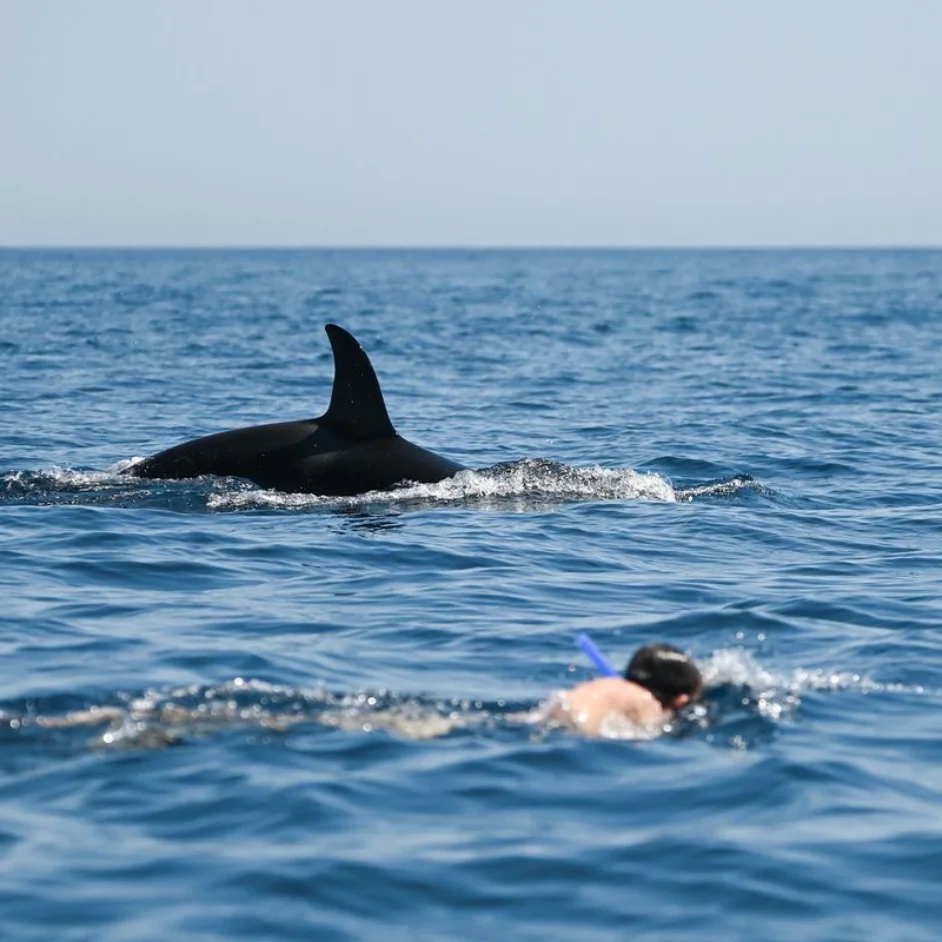
“We figured out why we weren’t seeing whales: there was a group of orcas in the area. And then we got to jump in the water with them. It was absolutely out of this world. One large male, about eight meters, a female, and a baby — all very calm. There was a moment where I was completely alone in the water. The big male was right in front of me, with what appeared to be the guts of a turtle in its mouth, just looking at me — so close I could have touched him — for about a minute straight, as if to say: “Hey, want to share?” The female swam around to my right and the baby was right behind me. That is a moment I will tell my grandchildren about. The first time I jumped in, I was absolutely terrified. But the moment I saw them and they actually interacted with me — they weren’t just passing by, they came back, they looked at me — all the fear just disappeared. The adrenaline was still there, but I would do it again in a heartbeat.
I even convinced my wife to jump in as well. She kept saying, “No, I’m scared, I don’t dare.” I told her: this is a once-in-a-lifetime experience. And eventually she said okay. She jumped in — and literally ten seconds later, one of the large orcas swam directly underneath her, maybe half a meter below, rolled to its side to look up at her. That was… wow. Just extraordinary” – Manuel F.
That’s the thing about Baja: it has a way of surprising you, even when you think you already know what to expect.
His full trip — 9 days at sea in Socorro followed by a week exploring Baja California — came to around CHF 8.000. Every detail taken care of.
If you’re thinking about combining Socorro with time in Baja, I’m happy to help you put something together.